


The wedding of Amy Hammond de Gruchy was one to remember, but sadly not for the right reasons. The glitz and glamour of this big event in Jersey over a century ago was long forgotten a few weeks later when the bride lay dead.
Typhoid was the cause and likely contracted from shellfish consumed on honeymoon in Brittany. If only she and her new husband had read a report published months earlier by one of their wedding guests, they might have avoided this terrible outcome.
Amy’s wedding took place in St Peter on 1 August 1910. The younger daughter of the parish’s Rector, her nuptials led to great excitement and all the grandees of the Island were there to celebrate the happy event.
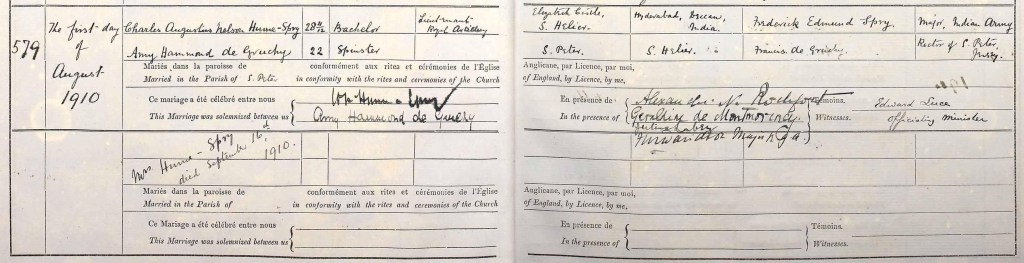
Also present were British Army top brass stationed in Jersey as the groom was a military man. The splendidly named Lieutenant Charles Augustus Nelson Hume-Spry, of the Royal Garrison Artillery, had been at Elizabeth Castle for the past four years.
Newspaper reports described the last preparations – prettifying the soldiers’ dress uniforms, finishing enormous flower arrangements in the church, and perfecting a triumphal arch with streamers, flags and flowers in the school grounds.
Amy, dressed in ivory satin and lace. walked up a crimson carpet lined with her fiancé’s comrades. The church was crammed and the service was a feast of music, with organ music and special psalms from the choir.
The newlyweds passed under an arch of soldier’s swords and proceeded to their carriage while Sunday School children strew rose petals in their path. The church bells rang and a reception for 200 people was held in a marquee at the rectory.
The cake was the “pièce de resistance”. It weighed 70 lbs, had three tiers and was decorated with cupids pealing bells beneath a filigree dome, as well as small field guns, military shields and even a miniature sugar fortress. The bride cut the cake with her husband’s sword, the Lieutenant-Governor proposed the toast, and the multitudes assembled to dine.
After all the excitement, the happy couple set off for their honeymoon in Brittany. Seven weeks later, Amy had died. She was taken ill with typhoid on honeymoon and worsened upon returning home. She died at St Peter’s Rectory on 16 September, aged just 22.

Florists supplied over 40 funeral wreaths, the organist played and the church choir sang, as they had done only the previous month – this time the rejoicing had turned to mourning. Later, Amy’s sorrowful father put up a brass plaque – still there today – in her memory at his church, where he would see it every day.
Typhoid is still a serious illness even with modern antibiotics and in 1910, there were six typhoid deaths in Jersey out of 20 cases – a high mortality rate.
How could a healthy young woman have caught such a terrible disease? Records do not say for sure, but it is extremely likely that it was from eating some of Brittany’s shellfish which, then as now, were a delicacy.
In his 1909 annual report, wedding guest and Medical Officer of Health Dr Paul Chappuis, noted with grave concern that cases of typhoid were being caused by eating shellfish from St Brieuc. This had been suspected since 1904, but in June 1909, a paper commissioned by the States’ Official Analyst set out a clear link between typhoid cases and eating infected shellfish.
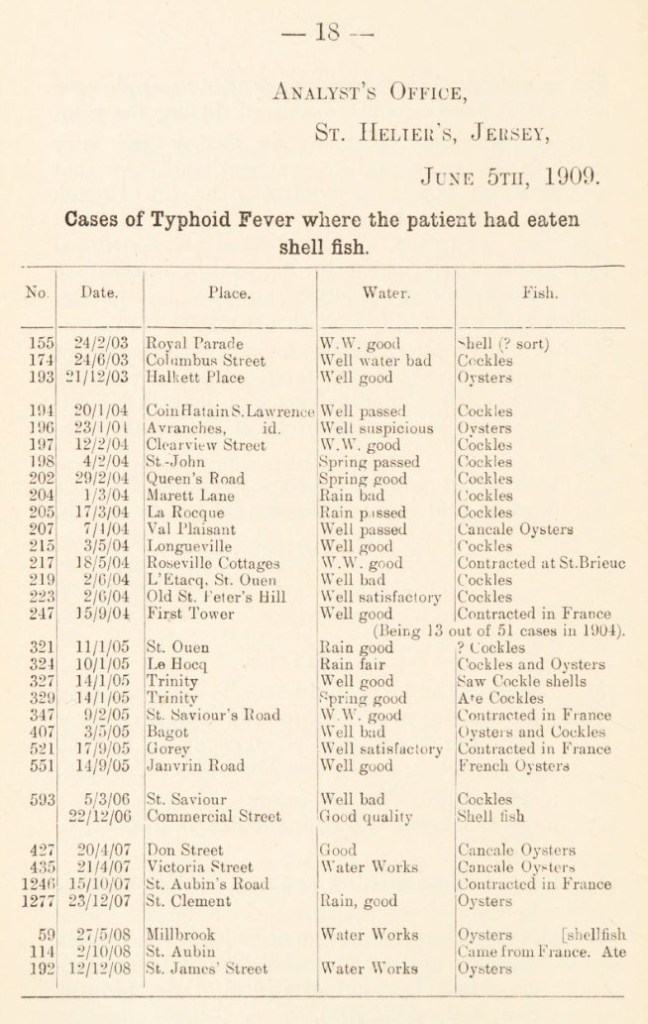
The report found that in 2½ years, 25 typhoid patients had the same thing in common – they had all eaten cockles in the preceding month, two or three of them in France, and one from St Brieuc. Cockle samples imported from the St Brieuc district were analysed and found to contain “two species of enteric bacteria characteristic of sewage”.
The doctor wrote that St Brieuc Bay, despite the recent construction of a sewer, still had water that often smelled “very offensive” and that it was “quite easy” for the cockles there “to become tainted by infected sewage”. Research from elsewhere had shown that ordinary cooking was no barrier to infection, only special steaming.
Dr Chappuis’ report concluded that the only options to ensure public safety were to compel Jersey’s only cockle importer to buy special steaming apparatus; to “issue an official notice warning the public against shell-fish” (the route that Guernsey had taken); or to prohibit their sale altogether. The States of Jersey took note and by the end of 1911, the sale of imported shellfish was banned.
In 1911, there were 16 typhoid sufferers – two caught it in France and one in England – but no deaths. The disease remained in low numbers in Jersey until a spike in 1915, but with the wider use of antibiotics it became rarer. An outbreak in the UK in 1964 was a reminder that typhoid was still around.
Charles, widowed after only seven weeks of marriage, left Jersey a few months later. He remained with the Royal Garrison Artillery and during the First World War, he served in France. In 1919, he married again – to another rector’s daughter, this time Frances Evelyn Howard of Battle, East Sussex.
- To hear more stories about the Island’s public health in temps passé, book your place at a talk at Jersey Archive on Saturday, 19 September entitled ‘Slums, Sewage and Sickness’, part of Jersey Heritage’s FREE ‘Discover the Collections’ event.
