

An islander who suffers from a chronic condition that causes extreme emotional or physiological reactions to noises such as chewing or breathing has set up a support group.
Tracey Anfray is part of the nearly 20% of people who suffer from misophonia – and she wants to raise awareness of it to help others and highlight how much it can affect a person’s life.
The 42-year-old recently set up a the Misophonia Jersey Support Group on Facebook to help others facing the disorder in which people feel strong emotional responses to certain sounds.
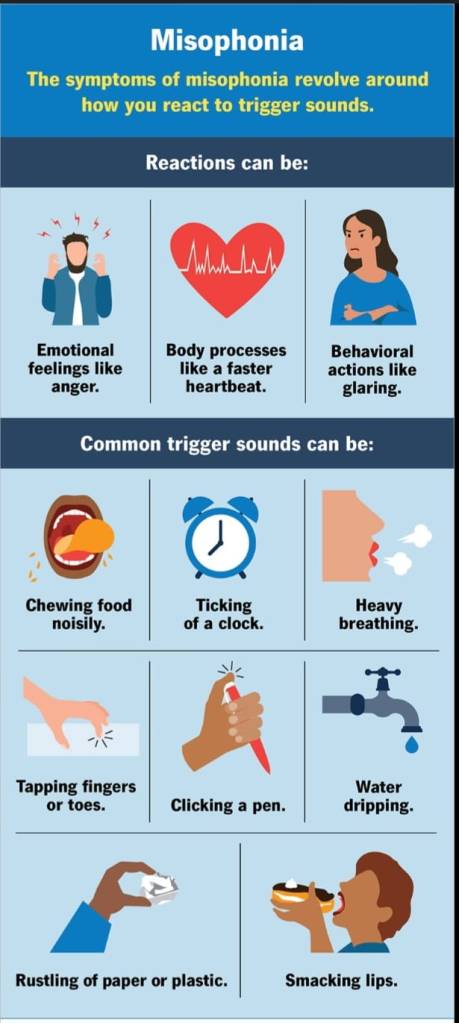
Triggers will differ from person-to-person, but can include people sniffing, eating and chewing, making sounds with crisp packets, clicking their fingers and slurping while drinking – especially hot drinks.
Tracey added that the majority of people did not understand that her responses to certain triggers were not simply down to her being fussy and that she has no control over her reaction.
“Nobody in their right mind would choose to live like this, because it doesn’t just affect one area of your life – it affects everything,” she said.
These aren’t things she simply dislikes; they cause extreme adverse reactions that she described as akin to “nails on a chalkboard” but “constant and all-encompassing” with much stronger intensity.
Her reactions can manifest emotionally, leaving her shaking with anxiety and even anticipating triggers leaves her “always on edge” in a fight-or-flight mode. They can also cause physical symptoms such as headaches and migraines.
It can feel so intense that it leaves her “shuddering” and feeling like her “ears are bleeding” – and it can feel like there’s a “rage boiling inside” of her, she explained.
The condition can also have an impact on relationships. For example, Tracey described how her misophonia made it too difficult to have dinner with her partner.
“I struggle to eat next to my partner because when he’s eating he hits his teeth with the cutlery,” she said.
It’s led her to decide not to have children, despite wanting them.
“Kids are totally out of the question,” she said. “I would love to have kids – but I couldn’t bear the thought of them living with this.”
Despite trying lots of ways to cope with the condition – including counselling, hypnosis, acupressure, medication, yoga and exercise – nothing has provided relief. Tracey has found that separating herself from other people is the only effective coping strategy.
“I have found nothing helps apart from being on my own, away from everybody, and it’s just not a way to live,” she said.
I have found nothing helps apart from being on my own, away from everybody, and it’s just not a way to live
Tracey Anfray
Tracey did not discover the condition had a name until she was in her thirties. She said this was initially a relief, because it meant other people were having similar experiences.
However, she soon realised that there is a lack of public and medical awareness about misophonia.
When she went to her GP, for example, Tracey was told it was a “mental illness”, when it is thought to be a “neurophysiological condition”.
On another occasion, after opening up to an employer, they replied saying: “Oh you’re a bit weird, aren’t you?”
As a result, Tracey set up a local support group to act as a “sounding board” for anyone in Jersey affected by misophonia.
“All my life I have tried to explain to people why certain noises and/or actions trigger a negative response both mentally and physically but, more often than not, I am just met with a complete lack of empathy and understanding,” she wrote in the group.
“It is treated as a joke when in fact it could not be further from [that]. This condition is destroying lives, it breaks families, and drives people to use mind-altering substances to block out triggers on a daily basis.
“Personally I find it very isolating and distressing, as it prevents me from doing normal everyday things that most people take for granted. I have depression because I can’t see a way out.”
You can find Tracey’s support group on Facebook.
