

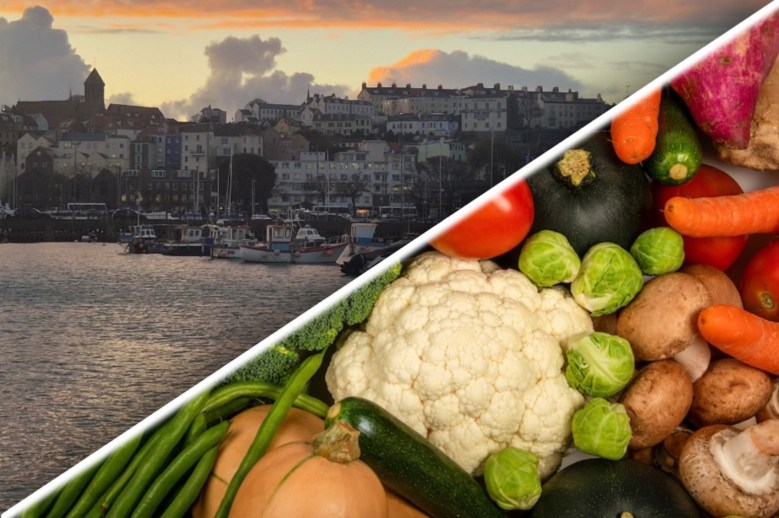
With Guernsey importing around 98% of all our food from the UK, local organisations are urging us to take heed of a UK government report that warns we could see signs of collapse in some ecosystems by 2030.
In the National Security Assessment on Global Ecosystems Report, the UK government claimed that “geopolitical competition will increase as countries compete for scarce resources including arable land, productive waters, safe transit routes, critical minerals”.
The report also stated that the “cascading risks of ecosystem degradation are likely to include geopolitical instability, economic insecurity, conflict, migration and increased inter-state competition for resources”.
Furthermore, it warned that “global scarcity would drive greater state intervention in supply chains, and securitisation of and conflict over food and water”.
For many in Guernsey this could be seen as a “so-what?”. However, the Bailiwick is totally reliant on our supply chains with the UK.
Almost all of our food comes imported from the UK, and the UK itself imports a sizable chunk from Europe or further afield.
The report explains that ”the UK relies on global markets for its food and for fertiliser. The UK imports 40% of its food from overseas, with over 25% coming from Europe”.
It continues: “the UK is heavily reliant on imports for fresh fruit, vegetables and sugar. Animal farming at current levels is unsustainable without imports – soy from South America makes up 18% of produced animal feed”.
One local organisation which has reacted to the news coming from the UK in Guernsey is The Soil Farm.
For more than a decade Sasha Marsh and Jock Pettitt have been championing small scale regenerative farming locally, and encouraging others to focus on a sustainable way of sourcing our food.
Following the publication of the UK Government’s report, Ms Marsh said that “for Guernsey, this matters even more. We import around 98% of what we consume”.
Mr Pettitt echoed her concerns, because as an island “we’re 98% reliant on that boat coming in”.
Together the duo have been helping drive forward the message that Guernsey needs to produce more of what we eat and use.
With the report from the UK Government, and climate scientists sounding off warnings, Mr Pettitt wants to look at the issue through a proactive lens, of what can be done.
“I don’t like to lead with fear. As I say, for me, it’s about, what are we doing?
“We set about our goal long before we read that report, and I’m pleased we did, because if this kind of data is accurate…
“We’ve been reading the ’60 harvests left’ narrative for a while now, and that’s down to environmental damage, not geopolitical and not climate.”
’60 harvests left’ refers originally to a 2014 warning from a UN Food and Agriculture Organisation official who said that, due to rapid soil erosion, the world could run out of topsoil in about 60 years.
It was then the title of a book by award-winning author Philip Lymbery, Global Chief Executive Officer of the international farm-animal-welfare organisation ‘Compassion in World Farming’.
Both warn of a rapidly approaching deadlines in which factory farming and food production in it’s current form isn’t sustainable, nor long for this world.
Locally though, there aren’t calls for a total food revolution, but more a push of encouragement for those who want to take a more hands on approach to providing what ends up on their plate.
Mr Pettitt said he would like to see an increase with more sustainable farmers, more hobbyist gardeners, and more taking up a proactive stance in cultivating food locally.
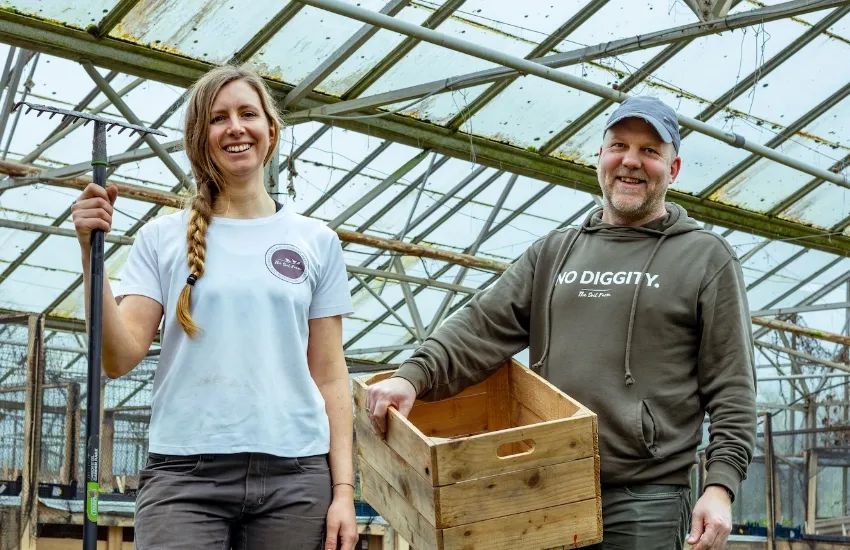
Mr Pettitt said even leaving these warnings aside, it makes more sense for Guernsey to aim for achievable goals in local production.
“We’re a small island. It doesn’t seem sensible that we’re 98% reliant on imports for what we eat,” he said.
“To achieve a third seems like a sensible goal, regardless of what else is happening globally.
“It also ticks a number of other boxes. It looks after our environment, if we farm it right and for me if we’re going to rebuild a farming system or a food system, let’s do it on values.
“It not only then attends to environmental welfare and helps us achieve much of our strategy for nature, our goals of bird life, and soil life, and wildlife, and habitat, and producing food and synergy with those, but it also attends to our health and community. Our hospitality, and to our food identity.”
On that last note of ‘food identity’, Guernsey is currently experiencing a bit of a quiet revolution in our restaurant scene.
Not only do we now have three restaurants in the Michelin Guide, we’ve also got a newly awarded Michelin Star for Vraic, and a Bib Gourmand for Alba.
Vraic’s Executive Chef has specifically spoken about his use of local ingredients, and his team’s successful drive to encourage “destination diners” to visit the Bailiwick.
So it could make complete financial sense for the Bailiwick to invest more in what we eat.
According to statistics released by the UK Government earlier this month (2 February), £324 million of goods were exported from the UK to Guernsey in the year leading up to the end of Quarter 3.
Not all of it, but a big chunk of it is what lines our supermarket shelves.
Mr Pettitt said there should be more attention on our locally produced goods, and we should start focussing on producing a wider range too.
“Our dairy should be celebrated, and so should our seafood, so should our beef, pork, our apples, rabbit!
“We had a tomato industry, we had a kiwi industry! We had these things and we have these opportunities to go outside of the normal UK reins.”
The team at the Soil Farm are truly passionate about what they do, and there’s a good reason for it. Life lessons learned during the COVID-19 pandemic and subsequent lockdowns, the reliance on our imports was laid bare for Mr Pettitt.
It was then that the importance of their business venture morphed from a consultancy focus to that of one producing, and trying to push a path towards a sustainable future.
“I made a promise to my daughter,” Mr Pettitt said. “We really started scaling up and thinking more business-like, about what we were doing as soil consultants.
“That was the time my daughter was being born. She deserves clean food and clean water. Her and her peers. She represents, for me, many a generation, and looking at the infrastructure we have, not just on the island, but globally, and you realise… you know.
“Covid came along and we looked in the mirror and thought, the farmers we’re looking for are in the mirror. We’ll go and do it ourselves.”
The project is one of passion for both Ms Marsh and Mr Pettitt. It’s one that is intrinsically rooted in who they are. Not just focussing on making sure the product is one that works for their family, but also for everything else that calls our island home.
“This is about first and foremost, feeding ourselves with healthy, nutrient dense food, ourselves and our family,” he said. “You realise that in doing that, you have a responsibility to attend to environmental welfare. We’re stakeholders in this.
“When you realise that you can farm in synergy with nature and improve those things through your actions, that’s a no brainer.”
As with everything in the news cycle in the current day and age, the report has been politicised, with some vocally doubting its accuracy and efficacy, but leading climate scientists aren’t amongst them, and neither are those in charge of producing our food.
For Mr Pettitt it seems that any doubts lead to one truth, that he wants to give that next generation of Sarnians an island they can be proud of. However, he knows he can’t do it alone, and it will require a shift in our communities collective consciousness to achieve.
“What we need collectively, whether it’s thrust upon us by a report that comes true, or the aspirational ones of today who are preparing for the worst case scenario of a report that comes true, is the community to collectively invest in an infrastructure that serves us today and builds something that we can hand on to our kids.
“So we can look them in the eye and say, we saw it coming, and here’s what we’ve done. We’ve prepared for this.”
It would benefit the Bailiwick too in taste alone, with some sci-fi solutions coming from the UK Government’s report including potential uses of AI, Lab Grown protein and insect protein becoming a British staple.
The report states that ”some technologies exist that could help, but need significant research, development and investment to have a chance of working at scale. Protecting and restoring ecosystems is easier, cheaper and more reliable”.
“The time required to develop and scale technologies is unknown without further research. Both existing (plant pre-breeding, regenerative agriculture) and emerging technologies (AI, lab grown protein, insect protein) offer potential solutions,” reads the report.
So what’s more appealing, a conscious drive by our community to focus on seasonal eating, locally growing, and investing more in what we eat, or the prospect of lab grown protein and insects?
It’s not just local sustainable farmers who’ve spoken out on the need for a change following the UK Government’s report.
Express has previously published the thoughts of the Nature Commission, which also wanted to focus on what can be done to mitigate any impact on our local environment, and empahsised that the predicted loss of biodiversity would have “profound consequences for the island”.
More to follow…
La Societe has also had its say, and Express will be bringing you its thoughts on nature corridors, and other ways to help our flora and fauna to prepare for potential changes.
