

An islander who developed a rare nerve condition as a result of the covid vaccine has criticised the requirement to be “at least 60% disabled” to be able to claim compensation.
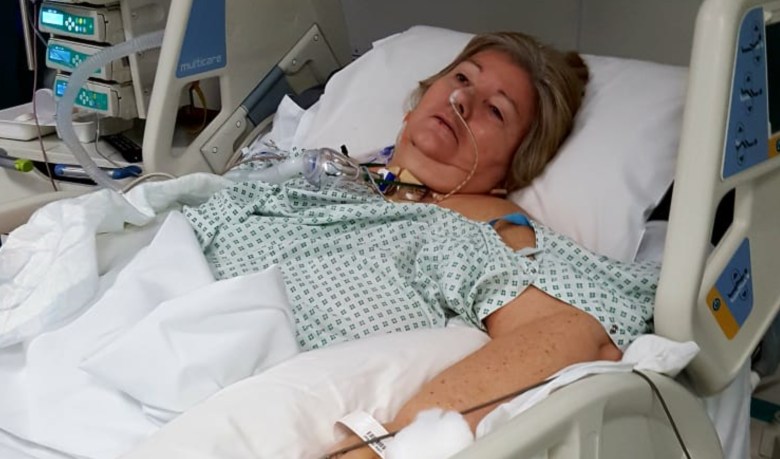
Jane Fulton was hospitalised when she lost feeling in her limbs just one week after receiving her first AstraZenaca vaccine.
She was diagnosed with Guillain-Barré syndrome – a rare condition that occurs when the immune system attacks the nervous system. It can be triggered by bacterial and viral infections and, in some cases, vaccines.
A correlation between a first dose of the AstraZeneca vaccine and a small but significant rise in cases of Guillain-Barré syndrome has been identified by UCL scientists, as part of an analysis of NHS data.
Documents seen by Express confirm Jane’s official diagnosis as “Guillain-Barré syndrome following first dose of AstraZeneca covid vaccine”.
She was paralysed from the eyebrows down, and spent five days in a coma and almost four months in hospital.
“My life will never be the same again”
Jane said that her life “will never be the same again” as a result of the vaccine – but she can’t claim compensation for what happened because she doesn’t meet the threshold of being “at least 60% disabled”.
The islander was initially told to claim compensation through the UK government’s ‘Vaccine Damage Payment Scheme’.
Covid-19 injections were added to this scheme, which enables those harmed by listed vaccines to access a one-off tax-free payment of up to £120,000, in December 2020.

But, at the time, the Channel Islands were not included in the scheme – and Jane was therefore told she was not eligible for compensation because she was “injected in Jersey and not in the UK”.
Jersey was finally added to the Vaccine Damage Payment Scheme almost four years later, on 13 May 2024.
According to the Government of Jersey’s website, “you can make a claim for the Vaccine Damage Payment Scheme if you were severely disabled by a vaccination administered in Jersey on or after 1 December 2020”.
It states: “Severely disabled means at least 60% disabled. This could be a mental or physical disablement.
“It’ll be based on medical evidence from the doctors or hospitals involved in your treatment.”
“Not disabled enough” for compensation
Jane has been told that she is “not disabled enough” to meet this threshold – but was critical of the fact that her case was assessed through a desktop survey, not a comprehensive in-person examination.

She noted that if she had remained bedridden, she might have qualified – explaining that her active approach to recovery actually worked against her compensation claim.
“I could have just laid down and done nothing at all to be permanently in bed and not able to do anything,” she said.
“But that’s not me, that’s not me at all.”
Jane explained: “There was a guy I was in contact with two months into my hospital stay.
“He’s in the UK, and he got Guillain-Barré syndrome through the injection too.
“And he said: ‘Jane, don’t try and get well too quickly, because you won’t get any compensation.’
“But I just want to be me again. I want to be able to get out of bed, and stand and do whatever I want to do.
“He’s now in a wheelchair because he didn’t push himself [to get better], and he’ll never walk again.
“He’s got to be fed, he’s got to be washed and cleaned. And yes, he got £85,000 compensation – but is it worth it?”
Criteria set under UK legislation
When contacted by Express, a spokesperson from Jersey’s Health Department said: “Health and Care Jersey are contracted with the NHS’ Vaccine Damage Payment Scheme to accept claims from Jersey residents.
“The UK Parliament established this national scheme and set the criteria regarding disablement under UK legislation. Jersey follows this national scheme.
“Jersey’s Director of Public Health reviews each assessment and recommends whether to uphold the claim based on the Vaccine Damage Payment Scheme’s medical assessment.”
Although Jane has recovered from the worst of her illness, it still impacts her life every day.
“You don’t realise how you take something for granted until you can’t do it anymore,” she said.
Jane was forced to move from her upstairs flat because of the fear of being unable to use the lift in a fire, and couldn’t close her eyes in the shower to wash her hair or she would lose her balance.
She cannot walk long distances, and struggles with staircases. She can’t drive any more as her leg tends to seize up, and has issues with balance.
You can read Jane’s full interview with Express here.
