


In most areas of life, we know that peak and off peak are very different.
Peak ‘rush hour’ in Guernsey means it might take you 45 minutes to drive in to town. Doing the same journey ‘off-peak’ might take you closer to 5 minutes.
When travelling off-island, train prices vary wildly between peak and off-peak times and booking flights or hotels in some countries’ ‘off-peak season’ can make a dream holiday more affordable.
Similar efficiency and cost saving benefits are achievable within our own homes and workplaces too, by making some very minor changes.
Guernsey Electricity encourages us to delay running our washing machines and dishwashers until the official ‘off-peak time’ while running hot water systems overnight is another change that GEL has pushed.
Joel Bramer, Operations Engineer at GEL, is one of the few people in Guernsey who can see the benefits of these small changes every day when he’s at work.
The control room at Guernsey Electricity’s power station is a room that few people have access to.
On the day we visited, Control Room Operator Dave Sweet was in charge – monitoring the island’s entire electricity usage.
Among all the lights and numbers on multiple screens, there is what looks like a digital clock showing exactly how much electricity GEL is importing or generating, and how much we’re all using.
“Dave’s actually controlling the entire electricity supply for the island, so both monitoring and controlling various aspects of it,” explained Joel. “Primarily he’s ensuring that the generating assets that we’re using are able to supply the demand the island requires. We have no control over what the electricity demand is on the island, it is entirely what the customer wants so if the customer wants more electricity, we just have to be ready to supply that.”
On the day we visited, Guernsey’s power was coming through the cable link from France.
Even that has its limitations though – and although it’s unlikely to be exceeded during the summer, Dave and his colleagues have to keep a close eye on the numbers.
“We import around 90% of our electricity from France via the cable, and that’s from certified renewable generation,” said Joel. “Everything above what we can import, we have to generate on island and that’s using our diesel engines. As we are at the minute, with the warmer months we don’t need to generate anything on island.”

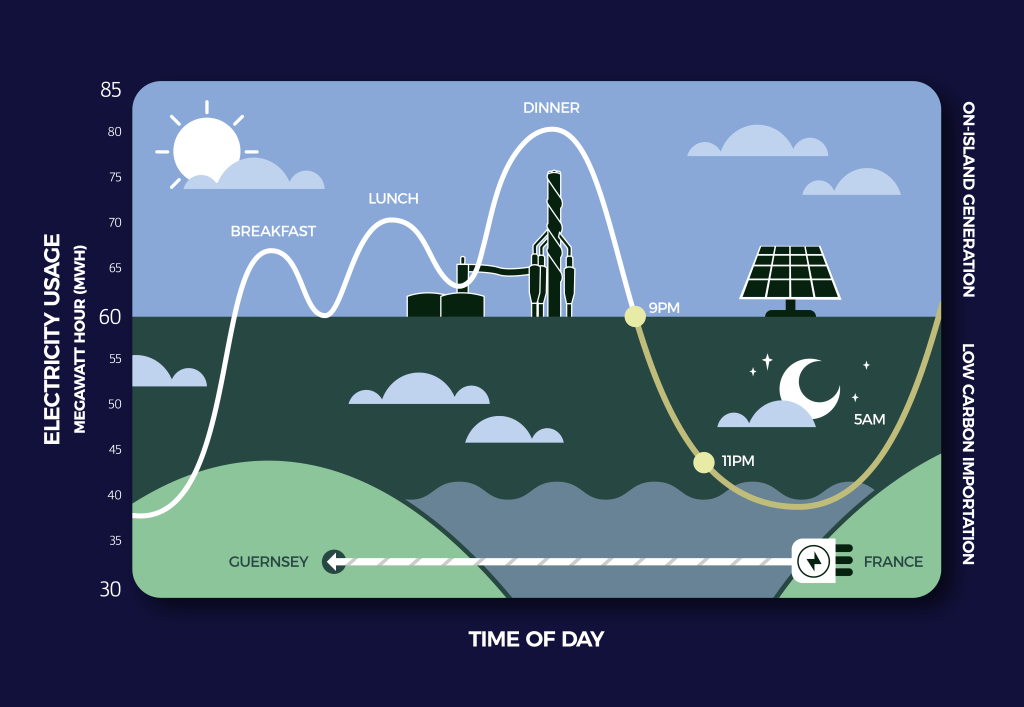
Guernsey Electricity can import 60 megawatts of power through the cable. At the time of our visit, the island was using and therefore importing anything around 38MW.
Anything above 60MW – or below that if the cable is out of action – is generated on island.
The fluctuating numbers are somewhat mesmerising, and they hold important information that can be analysed to predict when there may be peaks and troughs in our electricity demand.
Joel said the highest recorded peak was 94MW last winter, but it’s also dropped far lower than that.
“During the summer, which is when we have our lowest demands, we’ve seen it as low as 20MW,” he said.
“The import cable, it can’t go negative, but it could go down to zero. It would be happy to get down to very, very little, but it’s unlikely as there’re a lot of things that are never switched off. Things like your TV at home is on standby, and there’re plenty of essential services like at the hospital which will never be switched off.”
But the demand could be reduced during peak times by spreading demand and usage across 24 hours each day, said Joel.
GEL knows that certain peaks will always remain – such as the first cuppa in the morning as the island wakes up, and the dinnertime rush to get children fed and to bed each evening.
It’s also obvious that the amount of electricity being used is always going to be higher at 3pm than at 3am.
“We talk about three peaks during the day,” said Joel. “We have a morning peak that’s around 8am in the morning, we then have a lunchtime peak, and then we have the biggest peak, which is around seven o’clock in the evening.
“During the summer the level of those three peaks is relatively flat but during the winter months, the evening peak becomes much bigger than the morning peak.”

Flattening out those three daily peaks – and in particular reducing the evening peak – is one of Guernsey Electricity’s biggest targets.
If that could be achieved, the island could reduce its reliance on diesel engine generated electricity, and rely almost entirely on the imported power coming through the cable.
That target becomes increasingly important as we head back into the cooler and colder months, when GEL knows it will have to start generating electricity on island to top up the imported power to meet our daily demands.
The highest demand yet for electricity in Guernsey was seen in December 2024 when we were collectively using 94MW at one time.
With the cable able to import 60MW, the additional 34MW was generated on-island using GEL’s diesel engines at the Power Station.
It’s likely the peak demand record will be broken again this winter, but GEL hopes we can all work together to reduce it so we’re using less overall than we have done in the past, said Joel.
“The magic number would be probably 60MW. The import cable currently, as it is today, can import about 60MW. It does vary ever so slightly, depending on what’s happening in Jersey but as a rule of thumb, we say 60MW import is the ideal number. And if we could, in a perfect world, have 60MW all day, all night, 365 days a year, from our perspective, that subsea cable is being used to its optimum potential.
“We could not get any more out of it, but we’re getting our, you know, our full return on investment from that.”
Tomorrow… How we can reduce the peak by working together, saving money and reducing reliance on fossil fuels.
