


Claims that Guernsey’s S&P credit rating is likely to fall if the island rejects GST have been called into question after the very agency that awards the ratings clarified it does not take a position on specific measures.
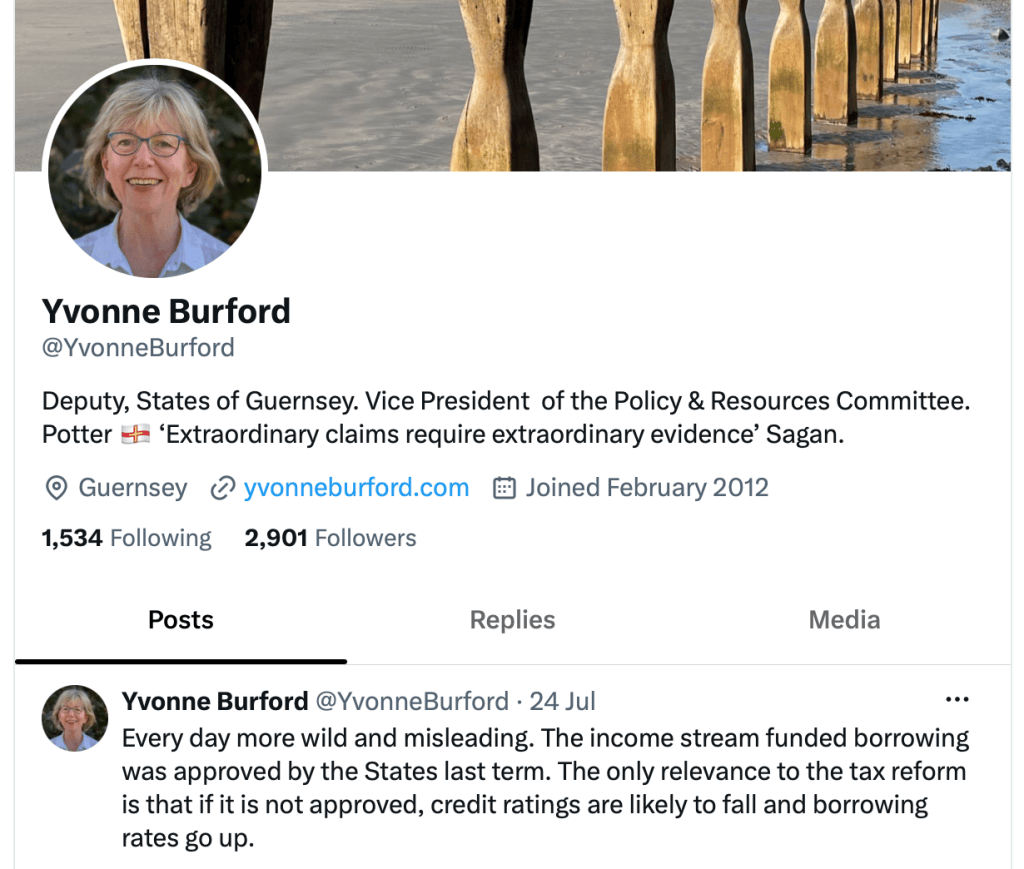
Following last week’s States debate, Policy & Resources (P&R) Vice President Deputy Yvonne Burford claimed on social media that if the GST tax package was “not approved, credit ratings are likely to fall and borrowing rates go up”.
Her comment echoed claims made by P&R Member Deputy Andrew Niles in the chamber and on a deputies’ WhatsApp group, and reinforced by P&R President Deputy Lindsay de Sausmarez.
Critics at the time labelled the warning “Project Fear”, calling it an attempt to scare deputies into nodding through the tax reforms.
Now S&P Global has now set out its position directly to Express, confirming it does not care whether Guernsey goes for GST.
A spokesperson told Express the rating agency does not “opine” on specific details of tax policy, and the current A+ rating was based on Guernsey’s “low debt levels”, “still sizable accumulated assets”, and the “medium-term overall direction of [its] fiscal policy”.
In other words, Guernsey needs to be well managed – its S&P rating does not specifically depend on GST being introduced.
Neutral
Responding to Express, S&P Global Ratings confirmed its position was strictly neutral, adding that its role was just to assess creditworthiness, not “opine” on specific tax or spending choices.
Instead, the agency made clear that a credit downgrade is only a risk if weaker budgetary performance leads to an “erosion of Guernsey’s liquid asset buffers” over time.
In plain terms, S&P does not care how politicians balance the books – whether through spending cuts, alternative taxes, or GST – so long as net debt remains controlled and general reserves are protected. (Read S&P’s full response below)
‘Extraordinary claims need extraordinary evidence’
S&P’s clarification appears to differ from the way some politicians characterised the agency’s position during the debate.
Critics have already pointed out Deputy Niles’ £250m borrowing figure and hypothetical £750k-a-year interest penalty were never set out or modelled in P&R’s 172-page Tax Policy Letter.
Instead, the figures were introduced verbally during the debate and in private messages, leaving opponents to decry the tactic as a “trial by ambush” designed to whip up last-minute anxiety in the Chamber.
While it was not in the policy letter, Deputy Niles’ attempt to link GST to the S&P credit score is not new.
When S&P published its rating report in February, Deputy Niles – then Vice President of Economic Development (ED) – hailed the agency’s comments as proof that tax reform was endorsed at an international level.
At the time, Deputy Niles publicly celebrated the report, saying: “Importantly, S&P recognises that a suite of tax reforms, including the introduction of a Goods and Services Tax (GST), is expected to be implemented from 2028.
“The agency states that these reforms will strengthen and diversify Guernsey’s revenue base, improve its long-term fiscal position, support the island’s capital investment programme, and reinforce fiscal sustainability.”
However, critics have argued that P&R has subtly shifted the goalposts between February and this month’s debate.

Deputy Niles previously pushed back against suggestions P&R was using GST to fund £250m of capital projects.
Speaking to local media, he insisted the goal was simply “explaining why protecting Guernsey’s S&P rating mattered” to keep future borrowing costs low for housing and energy infrastructure.
He claimed a credit downgrade could add £750,000 a year in interest charges.
But S&P’s statement confirmed that rejecting GST does not automatically trigger a downgrade – the body was clear that its ratings are not tied to any individual tax measure, saying any future rating action would depend on the overall direction of Guernsey’s public finances rather than GST in isolation.
‘P&R misrepresented the position’
The S&P revelation has drawn sharp criticism from deputies who argue P&R used private messaging and unsubstantiated warnings to sway votes.
Deputy Garry Collins, Finance Lead for Housing, told Express he was “very disappointed” by how the credit rating argument “came totally out of the blue in the tax debate”.
“Guernsey’s total net reserves have just increased to over £4 billion, with a £154 million increase on our group balance sheet just last year,” Deputy Collins said.

“Our debt is controlled and offset against income streams, so I agree, it feels like P&R misrepresented the S&P position just to push GST to States Members.”
Deputy Collins also revealed that Deputy Niles had pushed the S&P warning privately to politicians before the debate, while ignoring requests for independent scrutiny.
“Deputy Niles pushed on the States Members WhatsApp group before the debate that we needed [GST] to retain our current rating of A+,” Deputy Collins added.
“He [said] there would be a meeting with S&P soon and I requested if deputy observers could attend, which he never acknowledged or replied to.”
Alternative plans have same effect
A former civil servant and board member in the Treasury and Resources Department with a long career in finance, Deputy Collins stressed that alternative proposals – including spending cuts – could achieve the exact fiscal stability S&P was looking for.
He said alternative tax proposals or attempts to control spending – such as the Appropriations Committee amendment he put forward with Deputy Haley Camp – would “have the exact same effect, keeping our S&P rating stable”.
Confirming that it cares about the size of government debt rather than whether GST is chosen over spending discipline, S&P’s official statement appears to support this point.
With a seeming attempt to frame GST as an absolute prerequisite for protecting the island’s credit rating now dismantled, P&R is left facing difficult questions over why arguments not backed by S&P – and not mentioned in the tax letter – were deployed at the eleventh hour to push the tax package through.
‘A total red herring’
Deputy Rob Curgenven, who challenged P&R’s arguments about S&P during the Assembly debate, said the agency’s official statement demonstrated P&R’s credit score warnings were a “red herring” designed to force deputies into a corner.
“S&P’s actual report never once said Guernsey must introduce GST to keep its credit score,” Deputy Curgenven told Express.
“What S&P actually said was that if the States insist on pushing ahead with a massive capital spending program, they need to show how it will be paid for so liquid reserves aren’t drained.”
Deputy Curgenven pointed out that S&P’s report explicitly conditions any potential downgrade on spending “substantially” more on capital expenditure without offsetting revenue – a risk he said was created by P&R’s own capital ambitions.
“When you look closely at the tax policy, 76% of the money raised was going towards capital expenditure,” he explained.
“This wasn’t about frontline services, staff, or filling a black hole – it was going towards P&R’s wish list.

“We made an operational surplus last year, our balance sheets are going up, and we’ve got plenty of money. P&R created a funding gap because they want to spend an astronomical amount on capital projects, and then claimed we need GST to protect our credit score.”
He compared P&R’s approach to a household creating its own financial emergency.
“If a household is just breaking even, you don’t go out and buy a £10,000 sofa or take on massive new debt. You spend less, do what you can with what you’ve got, and look to grow your economy – which is exactly what S&P recommended.”
“Using the threat of a credit downgrade as a stick to push GST was a total red herring.
“S&P does not care about GST – they care about balance.”
Deputy Curgenven argued that S&P’s response exposes what he believes to be a fundamental flaw at the heart of P&R’s strategy.
“P&R tried to frame GST as an unavoidable necessity to stop borrowing costs spiking,” he added.
“S&P has now confirmed that is simply not true.
“The decision to push GST is a political choice by this committee to fund its spending spree, not an international credit requirement.”
‘They always fail’
Deputy Curgenven questioned P&R’s track record over delivery.
“They’re a bit like the England football team – they’ve got such high hopes but they always fail.”

He said part of the problem with the current debate was that Deputy de Sausmarez and some other members of P&R did not “understand the numbers”, but wanted other deputies to accept things “on faith”.
He said he and another deputy witnessed the Chief Minister being fed answers by a senior civil servant over a Teams chat, during a recent scrutiny meeting.
The hole in the credit ratings story
P&R’s campaign for GST began with warnings of a £50m annual “black hole” in Guernsey’s recurring finances.
But with key votes still on the line, P&R deployed the threat of an S&P credit downgrade and soaring borrowing costs in what opponents see as a high-stakes, eleventh-hour attempt to force the tax over the line.
S&P’s direct clarification appears to have dismantled that late argument.
By confirming that an ‘A+’ credit rating depends on medium-term liquid assets rather than any single tax policy, opponents of GST argue this means alternative approaches – including spending cuts and structural reform —could protect the island’s creditworthiness just as effectively as GST.
Below is the full, unedited statement provided by S&P Global Ratings to Express.
S&P’s full response
We asked:
I’m a reporter with Bailiwick Express in Guernsey. We’re currently covering the ongoing debate over the island’s fiscal plans, capital spending, and proposed tax reforms (including GST).
There are conflicting claims locally about what S&P’s position actually is on this, and I want to make sure we’re getting the facts straight. We aren’t asking for a comment on the local political debate itself, but we would love a quick clarification on two points regarding your Guernsey rating reports:
- Has S&P ever explicitly stated that introducing a GST specifically is needed to maintain Guernsey’s current credit rating?
- Or is your position simply that the island needs to demonstrate long-term fiscal discipline and show how large capital projects will be funded, regardless of which specific tax measures are chosen?
Any clarity you can share on this would be really helpful for our readers.
S&P said:
Many thanks for your question.
As a rating agency, our mandate is solely to assess creditworthiness and we therefore do not opine on the distributional aspects of budgetary policy, including which specific budget revenue or expenditure measures could be more appropriate, for example, from a business, social or fairness perspective.
Our current “A+” ratings on Guernsey with a stable outlook remain supported by the Bailiwick’s low debt levels in a global comparison and still sizable accumulated assets available to the government. We continue to closely follow Guernsey’s fiscal performance, like we do with any of the 142 sovereigns on which we have a public credit rating.
As we have said in our most recent published report, we could take a negative rating action if weaker budgetary performance resulted in an erosion of Guernsey’s liquid asset buffers. This is not about any specific revenue or expenditure measure in isolation, but rather about a medium-term overall direction of fiscal policy and its impact on the level of net general government debt.
