
The Government’s latest financial accounts show a mixed picture for 2024: rising tax revenues and better-than-expected savings, but also increased spending and a shift into deficit… Express took a closer look…
The Government reported a £63 million shortfall for the year, driven by higher departmental costs – especially in Health – and delayed capital spending.
Despite the deficit, Treasury Minister Elaine Millar said that “Jersey’s strength has always been built on prudent financial management, a commitment to living within our means, and making sure that we protect our reserves for the future”.
Income tax revenues rose sharply, largely thanks to higher earnings and strong business performance in the financial sector. While spending increased across departments, the government exceeded its savings targets and has put controls in place to limit future growth – such as the recruitment freeze and consultant spending ban.
Plans are already in motion to return to a budget surplus by 2027, the Government said.
Here are the key takeaways…
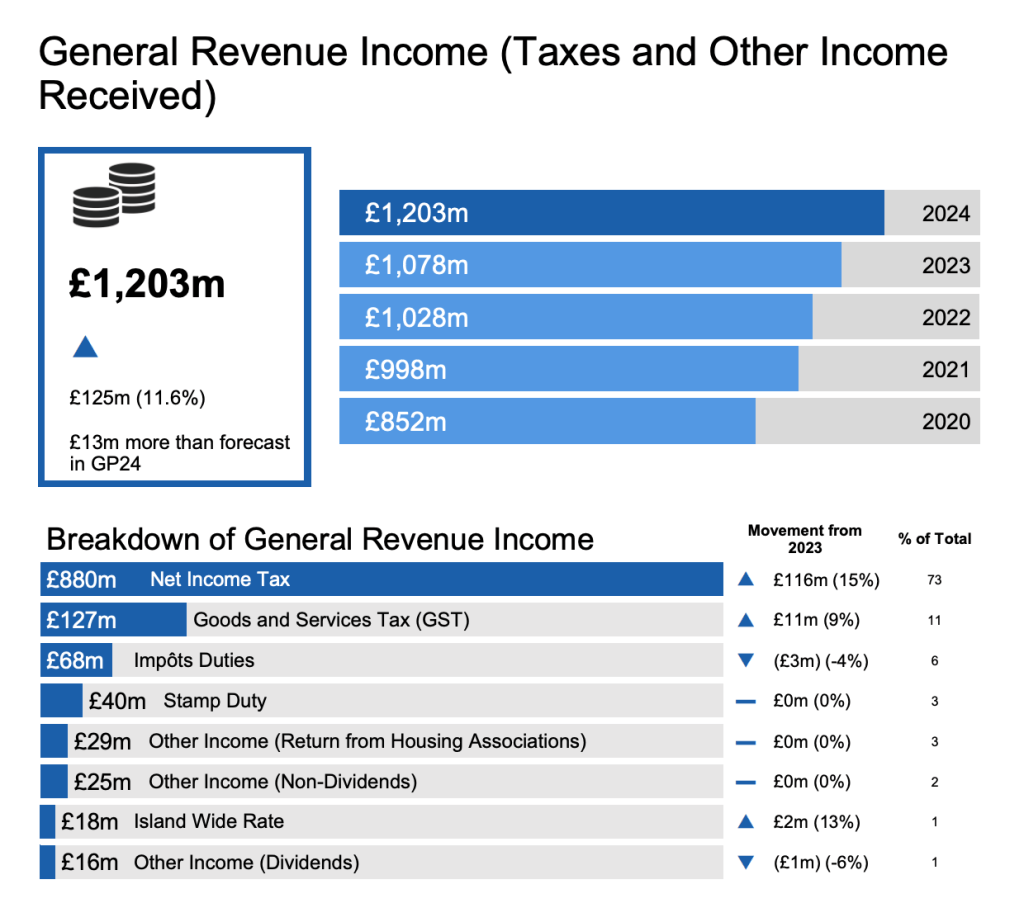
Income: £1,203m ↑ 11.6%
Income tax continued to be the biggest source of money for the government in the latest financial year. The government collected a total of £896.9 million in income tax, which included £705.4 million from individuals and £191.5 million from companies.
This amount is 17% higher than what was collected the previous year and even exceeded the government’s original estimate of £870.3 million set in the 2024–2027 plan. However, it was still slightly below the latest forecast, which had predicted £897.5 million.
The rise in personal income tax was mainly due to people earning more in 2024, especially those working in the financial services sector. Company income tax also went up, mostly because businesses – again, especially in the financial sector – made bigger profits.
Over recent years, the amount of unpaid tax has been going up.
In response, the government has tightened how it predicts and accounts for tax that may not be collected. This led to an increase in provisions (a financial safety buffer) of £16 million in 2024. While this helps give a more accurate picture of the government’s finances, it lowers the reported income figures.
That said, the government still managed to collect 80% of billed tax within 90 days.
Goods and Services Tax (GST) also brought in more money – up £11 million or 9% compared to the year before. This was largely thanks to new rules making big online retailers charge GST at the point of sale, even on purchases over £60. Higher consumer spending and inflation also played a role in boosting GST revenue.
Other income sources remained steady and were in line with both the government’s expectations and the most recent forecasts.
“Our income has improved significantly, driven by a strong economic performance,” said Deputy Millar.
Spending: £1,193m ↑ 17.4%
But expenditure has also risen. This, the Treasury Minister said, was due to “investment in critical areas, particularly healthcare and the Government’s strategic priorities”.
The ongoing impact of inflation on public sector costs and the reinstatement of the States Grant to the Social Security Fund at £77 million also contributed to increased expenditure last year.
Deputy Millar said: “In 2024, our tax revenues and day to day operational income exceeded our operational expenses, generating a surplus; however, this turned into a deficit after taking account of depreciation.
“This was largely anticipated in the Budget, but unexpected pressures in the Health Department have required us to draw on our contingencies to keep our spending within approved limits.”
How did each department do?
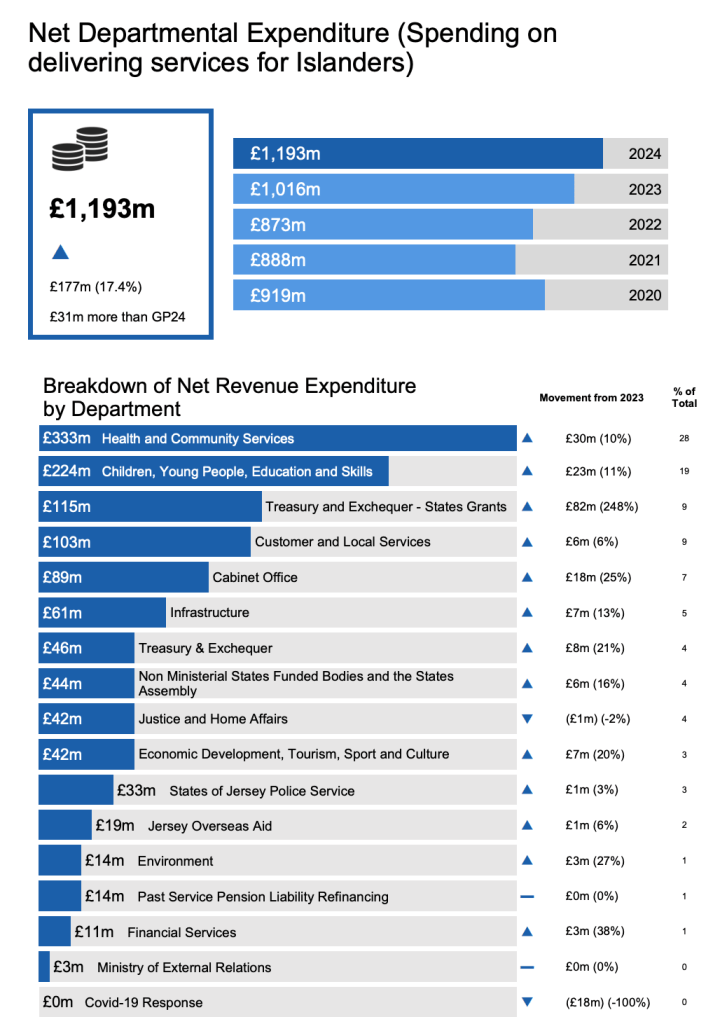
Government spending went up by £177 million (17.4%) in 2024 compared to the year before. Much of this was expected, with extra funding set aside in the Government Plan for rising costs like staff pay and the return of the Social Security Grant, which had been paused since covid-19. Without the Social Security Grant, spending rose by 9.8%.
Spending was £30 million higher than originally planned, mainly due to extra costs in Health and Community Services. Key increases included £88 million more in social benefits and £76 million in staff costs, partly due to an 8% pay rise and more staff.
The government also boosted spending on housing support, with £10 million going to the ‘First Steps’ scheme to help islanders buy homes.
Efforts to curb spending included freezing senior civil service hiring, cutting consultant use, and managing staff vacancies more carefully. While the workforce still grew, the pace slowed, and temporary staff costs dropped by £10 million.
A savings programme originally aiming to save £14.4 million actually delivered £18 million. Departments reduced costs through smarter staffing, internal promotions, reduced external spending, and delaying lower-priority projects. Health and Community Services alone saved £6.75 million, exceeding its goal.
Looking ahead, spending growth is expected to slow further, and the savings drive will continue into 2025 as part of ongoing efforts to manage public finances more tightly.
Capital projects
In 2024, the Government of Jersey spent £64 million less than budgeted on capital projects. One of the biggest underspends came from the New Healthcare Facilities Programme (NHFP), which is the island’s major hospital development.
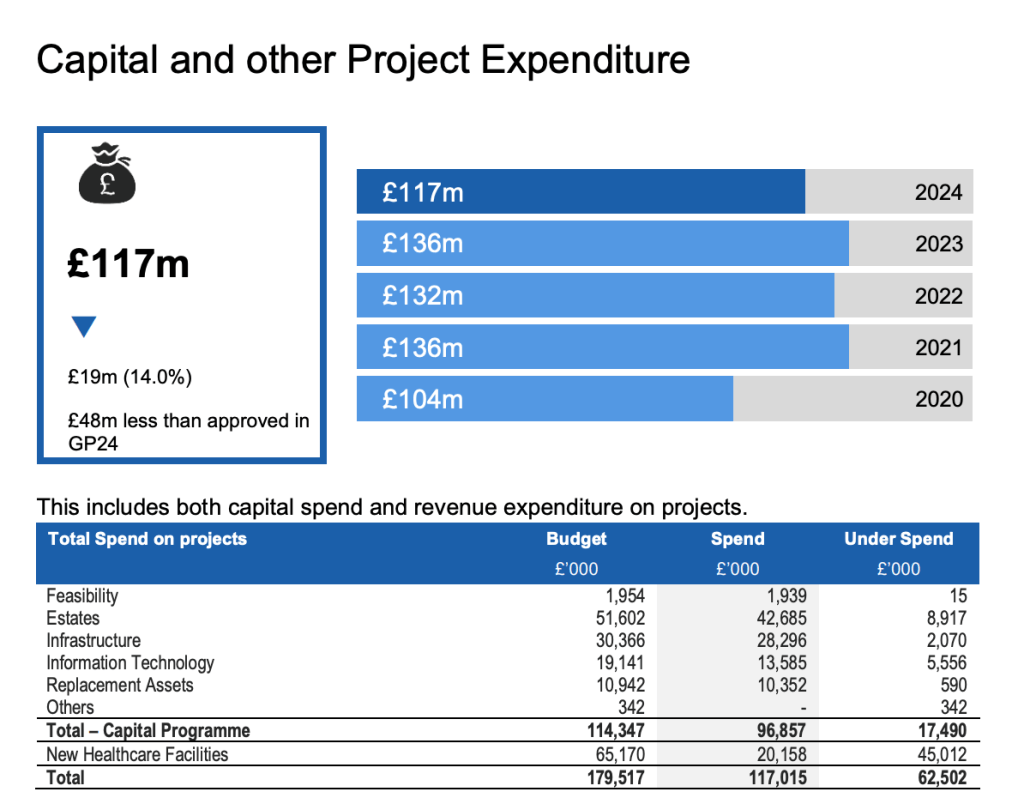
Although £65 million was approved for the NHFP – combining new funding and unspent money from 2023 – much of it wasn’t used yet. Most of the spending was planned for design and planning work, especially for the new Acute Hospital. Progress was made on design stages in 2024, with construction expected to start in 2025.
Some work also took place at St Ewold’s to create rehabilitation facilities, allowing demolition at the future Overdale hospital site to move forward. Other planned work, such as development at the Kensington Place Ambulatory site, was slower than expected but is now a key priority for this year.
Overall, most of the underspend is described as a delay, not a cancellation – costs are expected to be picked up in future years. This year, a main construction partner is set to be chosen for the hospital project, and groundwork is due to begin.
Underspent funds from other projects will be returned to the central government fund as planned.
How much we’re missing: £63m
The Government of Jersey ended 2024 with a £63 million deficit, a shift from a small surplus in 2023. This shortfall was partly expected, with the Government Plan originally forecasting a £28 million deficit due to major spending commitments like the return of the States Grant to the Social Security Fund.
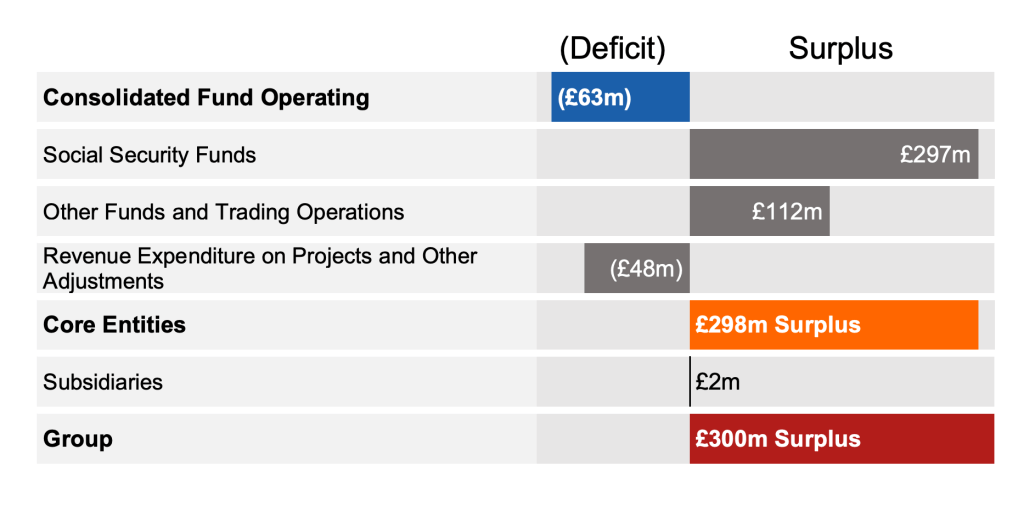
The deficit grew further after departments carried forward unspent funds from 2023 into 2024. These reserves were used to cover rising costs, particularly an extra £28 million for Health and Care Jersey services.
Despite the deficit, the government expects a return to surplus by 2027 with the Budget 2025–2028 set to outline further measures to control spending and reduce public sector growth.
Follow Express for more analysis…