

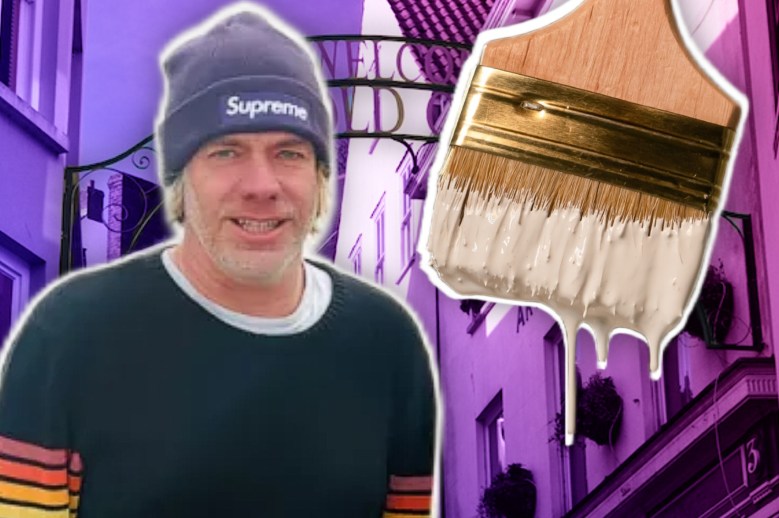
For the past week we’ve been taking a glance back at this summer’s ‘Diversion’ exhibition and pondering the question, “should Guernsey have a legal place to paint?”.
This could be akin to London’s ‘Banksy Tunnel’, a local version of Leake Street where the island’s artists aren’t just allowed by law to paint, but encouraged to do so.
On Saturday Express launched our podcast, ‘A Place to Paint’, and on Monday we heard from visiting artists Charlie McFarley and Teddy Baden, who both agreed it would be a benefit to the island.
Yesterday, Guernsey Arts took part through its Visual Design and Communications Coordinator, Jared Fox, who said the organisation would support an initiative, “should the right proposal come forward”.
Today it is the turn of local artist Tim Gaudion.
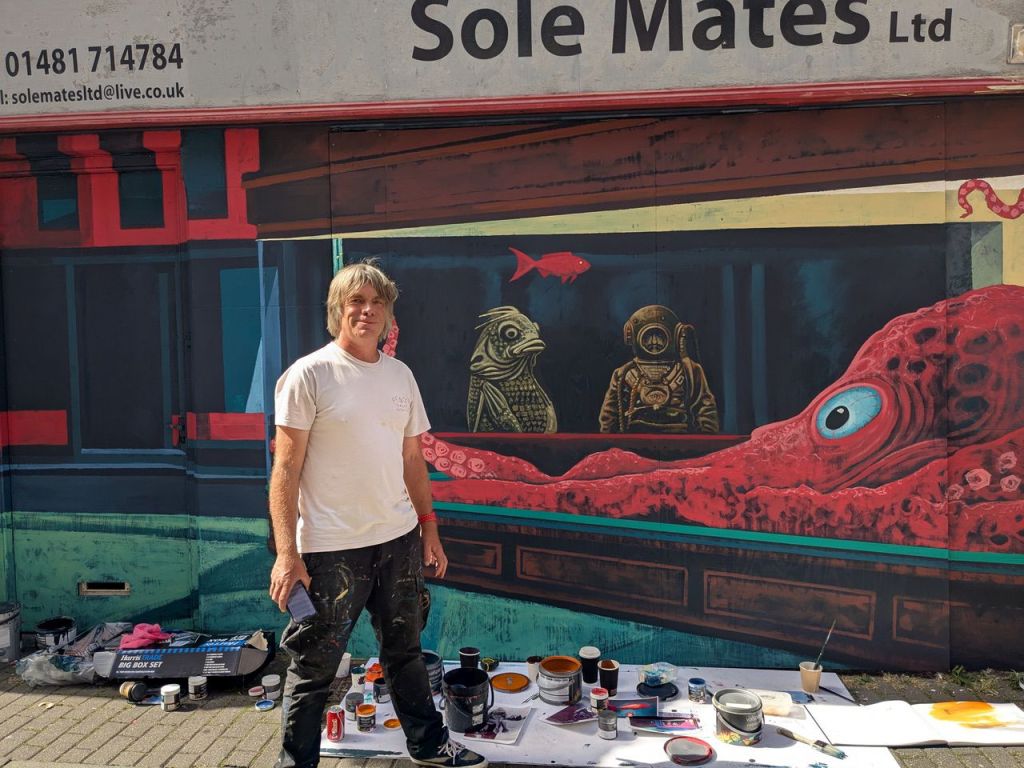
Tim’s Diversion piece stands out at the very top of the Old Quarter, a starting point for those treading the cobbled paths.
It’s a take on a classic, famous art piece, with a local twist inspired by news resonating with our community, and of course, some pun work for the finishing touches.
“There was a nice synergy with the octopus, and what’s happening in the news at the moment, or at the time, certainly in summer, with the shellfish industry and the octopus sort of decimating the crab stocks and the fishing industry,” he said.
“So that was a nice synergy there between the decline of the street and the area that we were looking to revitalise and bring back to life with some beautiful artwork. I also thought it had a really nice tie in with the story behind art for Guernsey, because they’ve had the big inflatable octopus out the windows for one of their earlier galleries.”
His piece also pointed to the ethos behind this summer’s street art exhibition, with a poignant focus on rejuvenation.
“I want to bring something into my piece that showed how the building could look if it came back to life. There’s a painting by Edward Hopper that I really like, Nighthawks. I started thinking about it a bit more, and I thought, well, that’d be really cool if I could take an old historic piece of art that I really like. It’s a scene in an American style bar/diner with a couple of people stood at the bar, and it’s really beautifully lit. It’s got the real sort of cinematic movie kind of feel.”
The experience of Diversion, painting in the street, with local and visiting artists had an impact on Tim, who like Teddy Baden alluded to earlier this week, saw the difference between painting solo, and painting in a cooperative environment.
“That bit was amazing, because as an artist, you often just work on your own in a studio. Just a pair headphones on, some tunes playing and that’s kind of it. You rarely interact with anyone else, apart from when you take it to show some of your mates or the person that’s commissioned it, or along to the gallery for the opening.
“Diversion was amazing, because it was like a party going on all week in the street. We’re all just painting the walls. All bouncing ideas off each other, kind of advising on ‘that color looks cool, what about this?’ that sort of thing. So it was a really nice, vibrant week in the street, and really, really pleased to have been involved with it.”
As well as speaking with the visiting public who wanted to see what was going on in the street, like all artists during Diversion, the presence of visitors made themselves known.
Mr Gaudion suggested that was due to the way people structure their holiday stops, with himself choosing to check out traditional streets and locations when he gets to travel abroad.
“When I go away, I always go to the ‘Old Quarter’ of a town or city, because it’s the cool place. It’s got the best bars, the best little cafes, and I noticed that there’s so many tourists coming to that area, because I think they’re doing the same! Looking for the Old Quarter that’s gonna be the best place to start exploring St Peter Port.
“They were really amazed to see all the artwork taking place, and really pleased to chat with us as artists. A lot of them told really cool stories about how street art had played a big part in their town or city, back at home, and even turned it into some sort of tourist attraction, with a summer festival every year, and then a year round amount of tourists coming in to see it.”

David Ummels, the founder of Art for Guernsey made the exact same point in his organisation’s piece earlier this week, focussing on the impact street art initiatives have had in London and in Paris.
Away from another lure for tourism, with a focus back on Guernsey soil, Tim was asked what impact does Street Art have on a jurisdiction from an artists perspective.
“I think it brightens it all up, doesn’t it? It’s something that I found really interesting since I finished it. It kind of changes people’s emotions, doesn’t it, whether it’s for the good or for the bad? I personally didn’t find anything negative, everyone was just pleased to see something happening in the street, pleased to look and enjoy the artwork.
“They all had different stories or emotional connections with the different pieces of work there. So I think on a larger scale, street art and any artwork, has got that emotional connection with people.”
During his exploration of street art, when preparing a series of talks to help educate the next generation of artists, Tim found an interesting way that towns in the United States manage to support street art, and brighten up forgotten areas.
“One thing I found really interesting, I’ve looked into a little bit more since, because I’ve done a couple of talks to schools, and a lot of towns, especially in America, when a developer puts money into development, a percentage of that money in some of the cities goes back into street art projects to kind of brighten up and revitalise other areas of the city, and bring art into people’s everyday lives as a talking point.”
So as a local artist, does Tim think ‘A Place to Paint’ should be established in Guernsey?
“I definitely think there should be a legal space, a wall that could be painted on, and with artwork changing regularly on it,” he said. “That would be absolutely amazing here.
“We did a project a couple of years ago, again, with Art for Guernsey at the Skate Park, where we got all the youngsters there involved with street painting, and Charlie and Teddy two of the artists involved in the Mill Street, Mansell Street project came over to help me with that.
“That was amazing, just seeing how inspired, and how it got the youngsters connected with the space as well, because they kind of then had a bit of an ownership on it, they’d been part of the artwork that was being created on the wall.”
Tim also suggested that temporary boardings around building sites could be livened up using the island’s creative talents.
“I think there’s a massive call out, and need for a space in Guernsey. I also think there’s so many places, at moment, when you drive around where there’s just kind of properties boarded up, or developments that are kind of on hold, like around B&Q, on the corner with there and Waitrose, that whole corner is just shuttered ply board.
“There’s numerous places like that. Those could all be turned into kind of street art spots, couldn’t they? That would be just amazing. It makes it look so much more interesting and exciting as well those areas of Guernsey, instead of just some dull, drab, rotting plywood that’s there at the moment.”
