

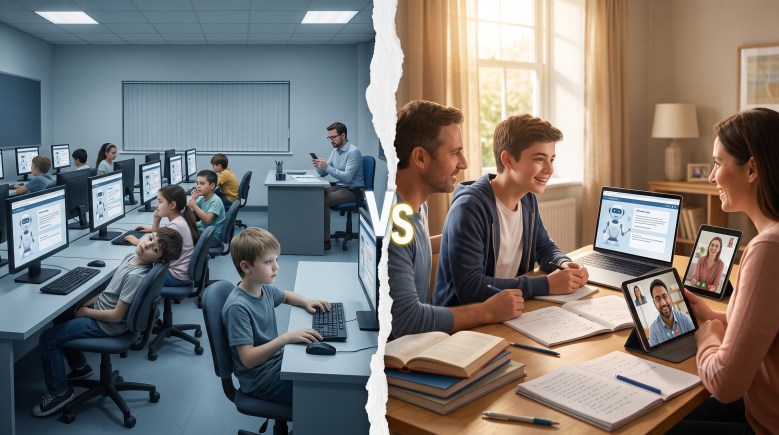
A Guernsey school announced last week that it’s taking part in an innovative trial of an AI tutor with a small group of Year 10 English students – prompting concerns from some parents online and to Express.
Elizabeth College was selected to take part in the four-week trial of Inkling, an AI-powered educational tutor which aims to help pupils focus on their set texts, ‘Of Mice and Men’ and ‘Whale Rider’.
We spoke to David Le Page – not his real name – who has two younger children at the school, as well as the school’s AI Lead, Fran de Garis, to hear both sides of the argument.
Does AI damage children’s relationships with teachers and parents?
Parent’s view: Mr Le Page told Express he was worried that using AI tutors could damage the pastoral relationship children have with their teachers – especially at a fee-paying school.
“If kids are struggling, they can knock on the teacher’s door at lunchtime,” he said.
Getting rid of that relationship went against the fee-paying school’s “core principles”, he argued, adding that it would be a mistake to “get rid of the pastoral work of the teacher outside the lesson”.
Mr Le Page said using AI tutors could also damage “the relationship and the bond children have with their parents over homework as well”.
“It may make kids go online more to seek out answers, as opposed to gaining that social connection and learning vital social skills – by just asking a chatbot.”

Teacher’s view: Ms de Garis said it was important parents asked the school “hard questions” and to “interrogate and scrutinise” the school’s approach to AI.
“I’m pleased we have parents who are informed enough to be asking these questions.”
Ms de Garis said there were no plans to use AI “in the classroom” and agreed it was important not to damage the relationship between teachers and students.
“We value the human connection as much as the parents do – there’s no way that we will let that [replacing teachers with AI] happen,” she added.
Ms de Garis explained that the trial was limited to 10 students, who would be using the AI just for homework and coursework.
She said the technology had been developed by Clifton College – an “elite independent school” in the UK – rather than a “big tech” company where profits trumped what was right for children.
It used an educational approach that forced students to spend time “thinking, and recalling what they know”, rather than giving them easy answers like ChatGPT might do.
She said Inkling would “give a little bit of guidance – literally a line or two – and then probe another question,” which often happened “much to the infuriation of the student”.
It could also give feedback to teachers about areas students needed help with, allowing them to tailor lesson plans, she added.
First and foremost the teacher remained in control of their students’ education, Ms de Garis said, with “professional judgement ruling supreme”.
Is AI teaching kids to become lazy thinkers?
Parent’s view: Mr Le Page said he was worried AI took away the challenge – and joy – of problem solving.
There was a real danger AI would become a “technological fast food”, with children valuing instant results over the “rigmarole of research”.
“They’re never going to be able to think for themselves if they become so reliant on AI, it’s a really, really dangerous combination.”
Teacher’s view: Ms de Garis agrees there’s a risk of AI having a “Google effect” on children’s memory – a phenomenon where people spend less time memorising facts they can look up online compared to previous generations.
However, she said that was part of the reason why the school was only trialing the technology – and hadn’t made a decision whether to adopt it more broadly yet.
Unlike off-the-shelf AIs, like ChatGPT, Inkling was trained to force children to ask and answer probing questions, rather than providing “lengthy and sycophantic” answers.
“We know as teachers that difficulty is desirable, and that learning is difficult.”
That’s why the AI tutor they were trialling didn’t just give the answers to students, instead asking them short, probing questions.
“The student will spend time thinking, recalling, retrieving what they know, and then Inkling will do the same thing again – much to the infuriation of the student.”
AI is trained on ‘stolen’ work – what is this teaching kids about ethics?
Parent’s view: Mr Le Page said he was worried about the “ethical lesson” using AI was teaching children.
Most of the popular AI models – including Google Gemini which Inkling is based on – are trained on copyrighted materials or previous students’ work without their permission and without paying them.
He argued that adopting these platforms implicitly signals to children that intellectual property theft is acceptable.
Teacher’s view: Ms de Garis admitted there was an incredibly “thorny tension” between the benefits of AI and some of the more “insidious” aspects of the technology.
“However the school was “trying to handle it in terms of knowledge, because knowledge is power”.
That was why partnering with another independent school, Clifton College, rather than a large “faceless” tech company was the right approach, she argued.
“This isn’t another big EdTech corporation who we can’t trust and have proprietary algorithms that we can’t interrogate.”
Clifton College’s education credentials also meant suitable “guardrails” were in place to protect children, including flagging any safeguarding concerns.
“Something I’ve not seen with other vendors is that Inkling insists on taking the designated safeguarding lead’s email address, so if anything untoward comes up [they get informed].”
What about the environmental impact?
Parent’s view: Mr Le Page was also concerned that using AI undermined Elizabeth College’s commitment to sustainability.
AI is well known to have very large environmental impacts, using vast amounts of electricity, as well as water to cool down processors.
He said: “This kind of goes against what they’re saying on sustainability.
“My question would be ‘Are Elizabeth College going to be doing anything to supplement the additional drain on resources that they will be putting on the Earth?”
Teacher’s view: Ms de Garis said she and many of her colleagues had been “quite shocked” when they learned about the environmental impact of AI during a recent session, adding that it was “a shocking and unnerving thing to learn about – very depressing”.
She said going forward, the environmental impact could form part of the school’s procurement process for AI technology.
“Let’s just say, hypothetically, we take on this tool, we might then look to see how much value it is actually bringing, and weigh that against the carbon cost of it,” she said.
Common ground
AI was “a phenomenon and not just a tool”, Ms de Garis said, which had informed the school’s “learn fast, act slow” ethos.
One thing both Mr Le Page and Ms de Garis agreed on was the importance of teaching children critical AI literacy.
Mr Le Page said children at the school needed to “look at more of the philosophy and ethics of AI, to change their perceptions for what they’re using AI for.”
They needed to be aware of “the dangers and pitfalls” of AI.
“Absolutely, let them have a go at using it, but with the correct mindset.”
Ms de Garis agreed, adding it was vital to “really emphasise that human dimension”.
“We hope that they will leave Elizabeth College knowing what the dangers are, the risks, and limitations.”
What Mr Le Page’s concerns had highlighted, she said, was that “actually we needed to be clearer on our vision” with parents and the wider public.
That meant a “careful, considered, learn fast, act slow approach – and yes, that does need to be communicated clearly going forward”.
“This has given an opportunity to do so.”
