

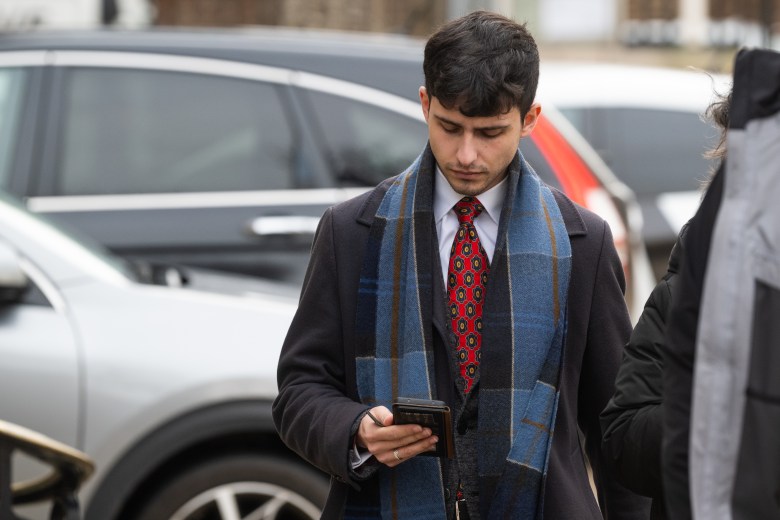
A trainee doctor whose promising medical career unravelled after he was caught secretly filming men using urinals has failed to overturn his voyeurism convictions.
Italian-born Diego Balassini was a Cambridge-educated doctor completing his foundation year at the Jersey General Hospital, with prospects of a further doctorate.
His name was across biomedical science prizes or outlining a “day in the life” of a Cambridge medical student.
But he found himself before the Royal Court in January after a gym-goer discovered he had been filmed naked in a changing room.
That confrontation sparked an investigation which uncovered videos of men using urinals in bars, at Jersey Airport and elsewhere, along with an archive of older recordings made before Balassini moved to the Island.
Police also found internet searches and Snapchat conversations containing repeated references to urination and voyeuristic videos.
Balassini never denied making the recordings. Instead, he argued that complex mental-health conditions caused him to dissociate while filming, claiming the videos were part of a pattern of self-sabotage rather than being made for sexual gratification.
Jurats rejected that explanation after a five-day trial in January, convicting him of nine counts of voyeurism.
Last week, Balassini asked Jersey’s Court of Appeal to quash those convictions, arguing that the trial judge had not properly reflected expert psychological evidence in his summing up and that the indictment had been incorrectly drafted.
Representing Balassini, Advocate Stephen Baker argued that an expert psychologist’s evidence had been overlooked and that the judge had shown an “overall imbalance” during the trial.
The Court of Appeal accepted there was “some force” in part of that criticism, but concluded it did not amount to a miscarriage of justice.
“The evidence as a whole showed that sexual gratification as a purpose was possible, though unlikely,” the judges said.
They concluded that this did not prevent the Jurats from finding, on all the evidence, that Balassini had filmed the videos for sexual gratification, describing that conclusion as “entirely unsurprising”.
The appeal judges also accepted that the indictment was “imperfectly drafted”, saying: “The omission of the statutory words is regrettable and should not be replicated in future cases.
“Precision in drafting indictments is important, particularly in sexual offences where the statutory language has been carefully chosen to delineate the boundaries of criminal liability.”
However, they ruled that the omission had not disadvantaged Balassini because he understood the case against him throughout the proceedings.
The appeal was dismissed by Jonathan Crow CVO KC, sitting with David Perry KC and Roddy Dunlop KC.
